We are so happy to announce that Ms. Brittany Robinson has joined Sophia Academy to help lead us into the future as an IWBMC Network School. She will serve initially as Teacher-Leader, overseeing the academic life of the school while carrying a teaching load as well.
Starting in 9th grade together, these new Sophia alums became the best of friends. We have watched them grow in stature, in self-control, in wisdom. Now they are both heading off to college. Wishing them the best!
Many families struggle to find an educational environment that meets both the neurobiological needs of their children and their desire for a Christ-centered, relationally rich education. Traditional schools, Christian or otherwise,—while strong for many learners—often lack the staffing ratios, therapeutic expertise, and neurodevelopmental structure needed for students with dysregulation, developmental delays, trauma histories, anxiety disorder, executive-function deficits, and other neurodevelopmental differences.
Sophia Academy has long been committed to awakening the unique genius in students with learning and developmental differences through a multisensory, hands-on curriculum and targeted interventions in reading, math, executive function, and social-emotional learning.
Families consistently praise the school’s compassionate environment as well as the academic and personal success experienced by their students. Sophia Academy’s current registration as a high school restricts our services to grades 9-12, but the need for deeper, more clinical, and more relationally-structured interventions is great in the community and across the school years.
Our art-based school enables students to work with both sides of their brainStudents find help from our mediation internOvercoming dysgraphia
Sophia Academy is working to transition to a Christian therapeutic-education school grounded in the Interpersonal Whole-Brain Model of Care (IWBMC™) from the Jacob’s Ladder Group serving grades K-12. The school would continue to offer our multi-sensory, hands-on education with small class size (5–7 students), individualized interventions (1:1 or 1:3), executive function coaching, SEL curriculum, and on-site counseling/social work support, We would add the neuroscience-based IWBMC model to target root brain-based challenges (not simply symptomatic behavior) leveraging neuroplasticity and whole-brain integration.
What is IWBMC?
Multi-faceted, whole child support
Supports neurobiological goals. Specialized testing enables us to design a curriculum that works for each student.
Belief in growth possibilities
Individualized curriculum for social, emotional, relational, physical, and academic needs
Wide Application: dyslexia, ADHD, trauma-related disorders, developmental differences, anxiety, and more
Teaching computer skills and tech to Sophia Academy students thanks to Unisys Cares!
This week Mr. Tom Tomer, electrical engineer with Unisys, shared exciting tech advancements and computer skills with students.
He and some of the seniors had a great time learning how to use the free computer graphics tool GIMP. The students were thrilled to see how they could place pictures of themselves in different visual settings and occupations, and improve photographs and works of art.
Different subjects, same hands-on discovery. As we welcome new students into our midst, we also are happy to report that we are now offering Spanish as a language option, joining the Latin we have offered for nine years. Spanish 1 is taught by Mr. Hazelton, our newest teacher.
Classes are bonding well even though we are only on day 4 of the new school year. This is what Sophia Academy is known for: a safe and welcoming environment where students who have experienced difficulty and failure in the past find academic and personal success.
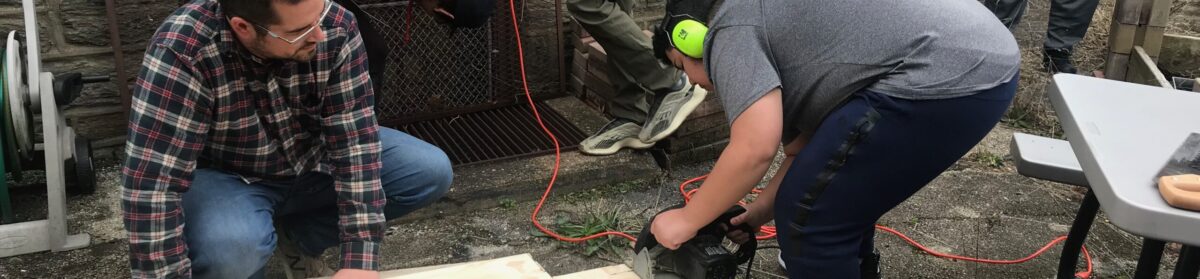
Sophia students participate ever year in the Philly Service Award project. This year, students in STEM classes are building –from scratch–a methane digester that can be used as an outdoor lamp or stove. It will be powered completely by organic trash. Anyone living in a city knows that there is usually plenty of trash to be found. Students have gone into the neighborhood multiple times to pick up trash, thus meeting two needs at once: beautifying the school’s neighborhood and securing a stash of free fuel for the methane digester. Win-win. Just another way for Sophia Academy students to use all their senses and abilities to learn.
For a school dedicated to awakening genius through creative discovery, it is important to find teachers who have caught the vision and love being pushed to be their best. Our new teachers this year fit the bill. Let us introduce Ms. Melody Heath (Temple U), new teacher of science and math, Mr. Aaron Vander-Collins (Liberty U, Rutgers), our new teacher of music.], and Mr. Jabarr Graves (Chatham U) new teacher of art.
Sophia Academy’s school year is hurtling to a close. As we continue to delve into history and science, math and literature, we also take time to learn outside the classroom. This spring, our field trips included an art-based trip to the Schuylkill River and its hiking trails, a science trip to Eastern University’s planetarium and observatory, and a hands-on trip to a New Jersey egg farm where we helped care for animals and made home-made pizza.
Looking for material for a natural sculpture a la Andy GoldsworthyBuilding a natural sculptureLearning to control the telescope from the computerDr. Bradstreet, Astronomy professor, explains how the telescope follows the sun
What is “authentic, hands-on” education? Education that prepares students with skills they can use in the adult world of 2022 and beyond. As part of Sophia Academy’s mission to awaken genius in students with language-based learning differences, we are always seeking to find ways to give our students practice with the same skills they might use as an adult.
We were fortunate to receive an award for the school as part of the Excellence in Teaching Award given to Mr. Brockman. With that award, we purchased curricula and equipment to enable students to learn design and development skills as they use tinkerCAD. Our new 3D printer has students quite excited!